Research
Complex forms matter not for their complexity, but for the spatial, structural and material qualities they produce, and because they raise directly the question of how they are built.
Framework
The research is carried out at the LACTH laboratory of ENSAP Lille, with the GSA Lab at ENSA Paris-Malaquais and the Architectural Mathematics Group. It follows three lines.
01Robotic additive manufacturing
Form, material, machine
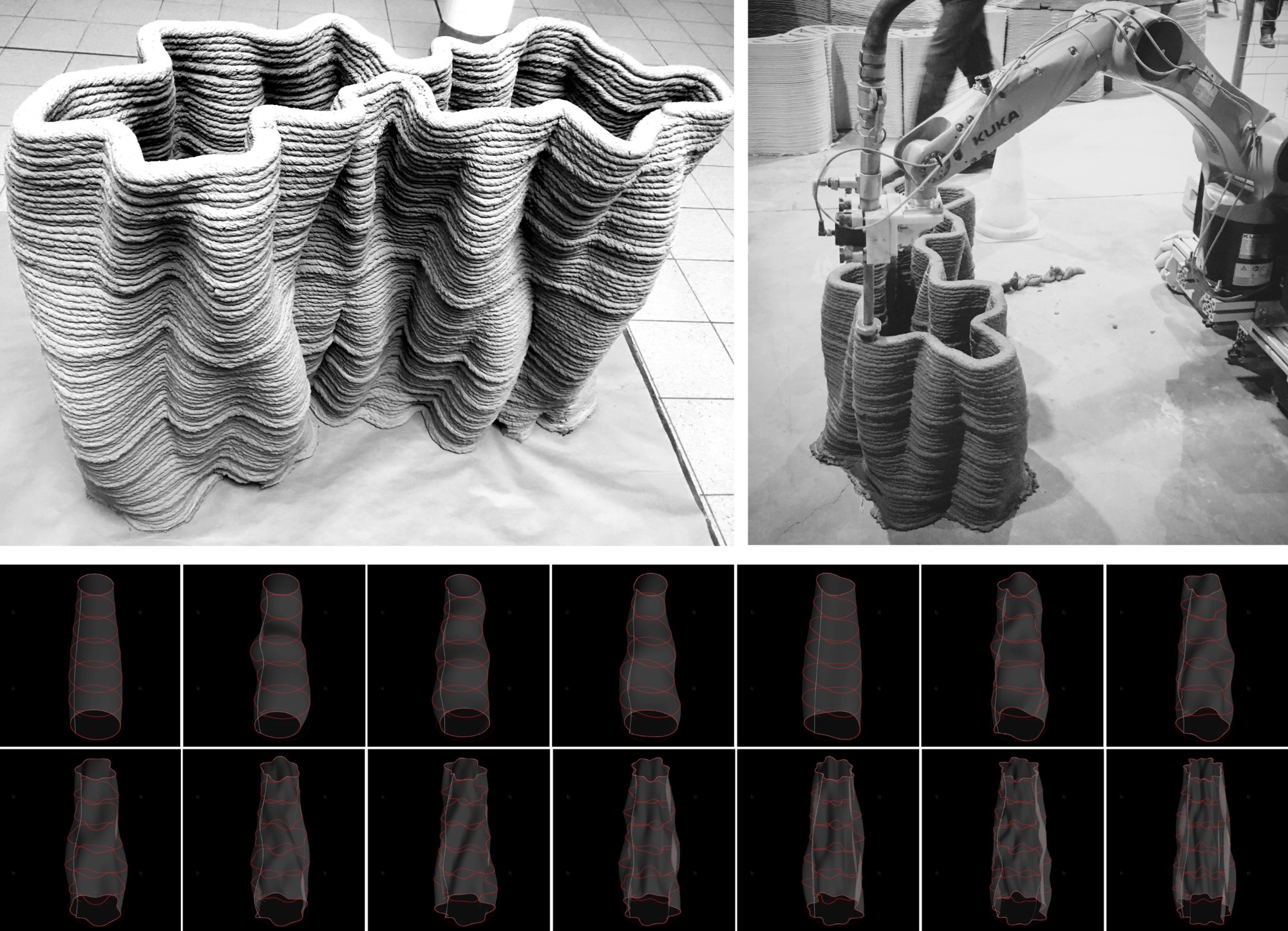
What can additive manufacturing produce for architecture? The work treats design and digital fabrication as one continuum: forms are oriented toward fabrication, and form, material and machine are adapted to each other.
The questions are practical: constructability, robotic deposition, fabrication without formwork, robot trajectories, texture and layering, and prototypes at architectural scale.
02Geometric rationalisation
Minimal surfaces, curvature networks, discrete systems
How does a doubly curved form become a set of parts that can be cut, assembled and paid for? The research works with minimal surfaces, principal and asymptotic networks, developable strips and planar panels, and tests each idea at full scale.
Post-rationalisation
Generated surfaceRationalisationFabrication
- Great freedom of form
- An open architectural approach
- Construction adapted step by step
- Rationalisation is more complex
- Geometry has to be adjusted
- Precision varies more
Pre-rationalisation
Geometry made for fabricationPrototype
- Constructability built in
- Geometry parameterised for fabrication
- High precision in construction
- A narrower field of forms
- Work starts from families of mathematical surfaces
- The architecture is guided by the properties of the system
The Architectural Mathematics Group, co-founded with partners at ENSA Paris-Malaquais, the University of Minho and TU Dresden, carries this work: mathematics and geometry in architecture, fabrication-aware geometric systems, gridshells and lightweight structures.
03Iranian architecture and geometry
Muqarnas, reinterpreted
Part of the research reads Iranian architecture through contemporary geometry and fabrication, starting with the muqarnas. The aim is to extract principles that can generate new spaces, structures and ways of building, not to reproduce historical forms.
Further research
- 2018
- Prefabricated complex concrete vaultsWith CEMEX and the GSA Lab, ENSA Paris-Malaquais: new manufacturing methods for complex concrete vaults using folding logic.
- 2016
- Porous Habitat ModelWith 1431 Studio, Iran: algorithmic design of a nature-integrated housing system for an eco-district in Del-e-Alam, Iran.
Publications
- 2024
Li, X., Mansouri, M., Elshafei, A. “Minimal surface based elastic gridshell design.” Proceedings of the IASS Annual Symposium 2024, Redefining the Art of Structural Design, Zurich, 26 to 30 August 2024.
- 2023
Abdelmagid, A., Elshafei, A., Mansouri, M., Hussein, A. “A Design Model for a (Grid)shell Based on a Triply Orthogonal System of Surfaces.” In: Gengnagel, C. et al. (eds), Towards Radical Regeneration, Design Modelling Symposium Berlin 2022. Springer, Cham, pp. 46–60. doi.org/10.1007/978-3-031-13249-0_5
- 2020
Mansouri, M. Réinterprétation des muqarnas : développement historique, modélisation paramétrique, fabrication. Doctoral thesis, Université Paris-Est, GSA Lab, ENSA Paris-Malaquais. Supervisor: Matteo Porrino.
Talks
- 2026
- “Construction des morphologies complexes : rationalisation géométrique et fabrication additive.” Conférence STA CIMA 2026, ENSA Paris-Malaquais, 2 June 2026.
- 2025
- “Form, material, machine: computational design, digital fabrication and the dialogue between architecture and engineering.” Summer school lecture.
Exhibitions
- 2018
- La Condition Publique, Roubaix: large-scale 3D printed pavilion and elements from the MATRICE project.
- 2016
- European Heritage Days, Pavillon Boncourt, Paris: doctoral prototypes, with the GSA Lab.